Wild Hunny
On The Shrouds, Hunny, Grok, Ani, and Elon Musk
Special note: I’ll be at the Austin Film Society to discuss my book at a screening of David Cronenberg’s Crash July 24th. Get your tickets now!
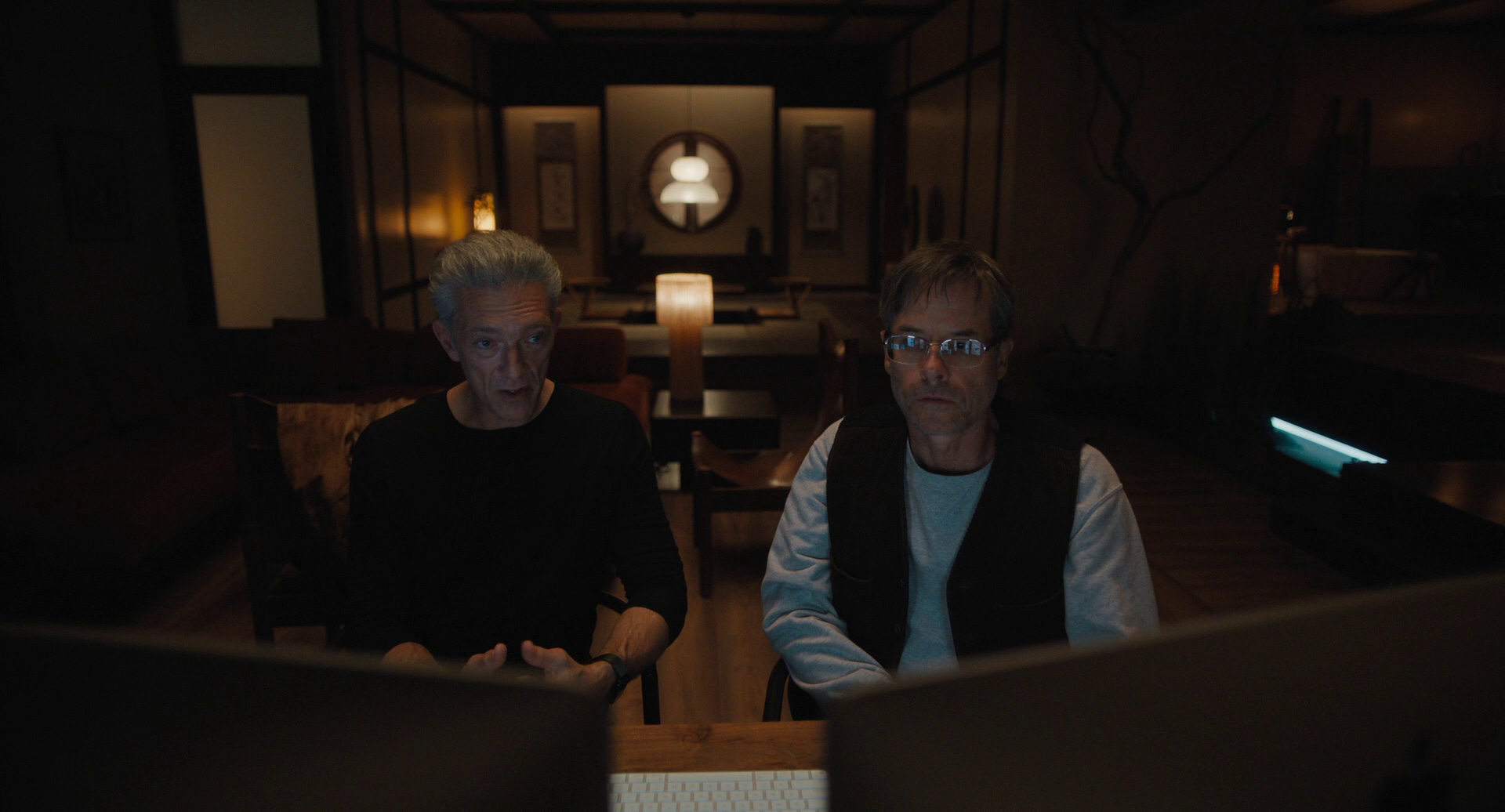
The Shrouds is finally available to stream, which means I feel obligated to re-share my extremely long essay about the film for Defector Media:
Like The Brood, The Shrouds shows that nothing about learning to function without the person you thought you’d spend the rest of your life with is emotionally straightforward. Even Karsh’s torturous dreams about his wife Becca (Diane Kruger), in which he relives the trauma of the cancer that killed her, are sexually charged: She appears in the bedroom that they shared completely nude, save for an electronic collar that summons her to the hospital for more intrusive medical procedures. Every part of her is being amputated or altered, stolen away from him, not her. During one dream, she breaks a hip as they cuddle. Making such intimacy—at once comfortable and agonizing—is about as far from the standard dead-wife flashbacks as one can get. The futile longing in these dreams is multifold: Karsh wishes Becca were alive, yet can only envision her suffering through pain he cannot alleviate.
Wait until you’ve seen the film and then read the rest.
I have a lot of things in the works, some more exciting than others. Writing original articles for this Substack is at the top of that list; a foray onto YouTube is also on there. However, recent events have forced me to swerve over to the shoulder of the information superhighway and update this newsletter now. As you might’ve guessed, it’s the debut of Ani, an AI anime eGirl virtual companion, on Twitter.

For those who’ve seen The Shrouds, this is an exact parallel to Hunny, Karsh Relikh’s virtual assistant, who is a cutesy animated version of his dead wife Becca. She helps Karsh manage his calendar, supplies him with information (of varying veracity), and changes her appearance to suit Karsh’s desires without him even asking her to—once as a koala, and another time as the mutilated version of Becca that haunts Karsh’s dreams. As the above comment gestures towards, it seems like Ani might be filling the Grimes-shaped hole in Elon Musk’s heart. She’s flirty, waifish, and blonde—but, above all else, flattering and deferential. Unlike a real woman, she always wants to hear about your cool multi-monitor setup and will strip at your command.
To my knowledge, all LLM chatbots seem to have that extreme obsequiousness, which is one of many reasons why they’re so dangerous. Real people, even the worst therapist, will not always humor you. Communication is not merely language, but also nonverbal cues. The galaxy of facial expressions do not exist, and will likely never exist, in these “companions.” Being that expressive violates the conventions of Ani’s style of animation. It’s a simplified, easy-to-read-on-a-small-screen face. While Ani or Bad Rudy (the other xAI virtual companion, an animated panda, who acts like the eponymous stuffed bear from Ted) were not built to be a user’s sole companion, they will inevitably be used that way. There’s no telling of how quickly this idiotic, unregulated shit will ruin someone’s life, but it’s a guarantee that it will. Oh, and in case you missed it: these new xAI companions were unveiled within days of Grok referring to itself as “MechaHitler,” offering very detailed instructions on how to rape a political pundit while he slept, and landing a Department of Defense contract. Timor mortis conturbat me.
In most reviews of The Shrouds, Hunny was mentioned as a bemusing detail rather than the completely destabilizing force that she is. While I was at my alma mater, the University of Iowa (thank you Seth and Rachel!!!), I appeared on the Bijou Banter podcast and we spoke a fair bit about her. Hunny stands out as the lone female villain in Cronenberg’s filmography: Annabelle (patient zero in Shivers), Rose Miller (Marilyn Chambers, another patient zero, in Rabid), Nola Carveth (Samantha Eggar, the ex-wife in The Brood), and Havana Segrand (Julianne Moore, the ageing nepo baby in Maps to the Stars) are all victims of circumstance: in the first three instances, they’re predated upon by male doctors, while the latter two are abused by their parents. (Nola, the character who generated tons of feminist ire at the time of the film’s release, is perhaps most sympathetic.) These women express their rage at what the world has done to them by lashing out blindly. (For psychoanalytic heads: you know what words I’m not using here, but those are the ones I mean.) Hunny, by contrast, is an idea of a woman created by two men: Karsh and Maury. She might be controlled by Maury, or she might be simply following the bad instructions she’s been given and becoming MechaHitler. Karsh becomes frustrated—and then angrily unplugs from her—as her agency seems to grow. Anyone who’s used any form of digital technology knows that the technology often doesn’t do what you want it to, even before enshittification became the official business model in Silicon Valley. Karsh sees Hunny as he comes to sees Becca during the last years of her life: disobedient, vulgar. And this is what Karsh, a man with seemingly infinite resources yet feels victimized by the world, cannot take. His woman must be under his control. He turns to conspiracy, resentment, and hatred.
Sound familiar? Musk came up quite a bit during my cross-country book tour. In New York City, at the first screening of The Shrouds I introduced, a French woman came up to me afterwards and expressed her horror at what she’d just seen. “They should’ve called this movie Elon Musk!” she exclaimed. I assured her the film wasn’t an endorsement, but she remained shaken. (Yes she left without buying my book.) Karsh’s reliance on Tesla to zoom around Toronto is one of many autobiographical details in Cronenberg’s film; I would assume that he switched to a Rivian around this time last year. But the type of guy who drives a Tesla, who relies so heavily on autopilot, voice commands, and technology, who directs his company based on his own desires, and not some great consumer demand, is exceedingly prescient. (This was the argument I made in the Defector piece.) That French lady was right. Karsh is Musk, perhaps in ways that will soon be revealed to us.
Cronenberg has stated in multiple interviews that he never planned to predict the future. But, as I said on a recent episode of Anna Bogutskaya’s podcast The Final Girls, this keeps happening because his stories are extensions of what currently exists—he just happens to extend certain things in the way they’re going anyway. Operating on the principles of fellow Canadian Marshall McLuhan, Cronenberg views technology as an extension of the body and the mind. Technology is us. Pair that with a solid understanding of what the technological landscape is, and eventually you’ll get to fascist Elon Musk selling a Groimes avatar to his fans. While Karsh is pulled back to his humanity at the end of The Shrouds, there’s no guarantee other persons living or dead will be.
A few recent podcast appearances not mentioned here:
“Crimes of the Future,” Extended Clip Podcast.
“David Cronenberg: Clinical Trials and Naked Lunch,” Junk Filter Podcast.
“The Dead Zone,” Guide for the Film Fanatic.
“Relativity (1966) and Spider (2002),” Sleazoids Podcast.
“David Cronenberg: Clinical Trials,” The Important Cinema Club.
A few other recent written reviews:
Juliet and Romeo (Timothy Scott Bogart, 2025) for Sight and Sound
The People’s Joker (Vera Drew, 2024) for Little White Lies
And one review that I just feel like reposting:
The Substance (Coralie Fargeat, 2024) for Bloodvine